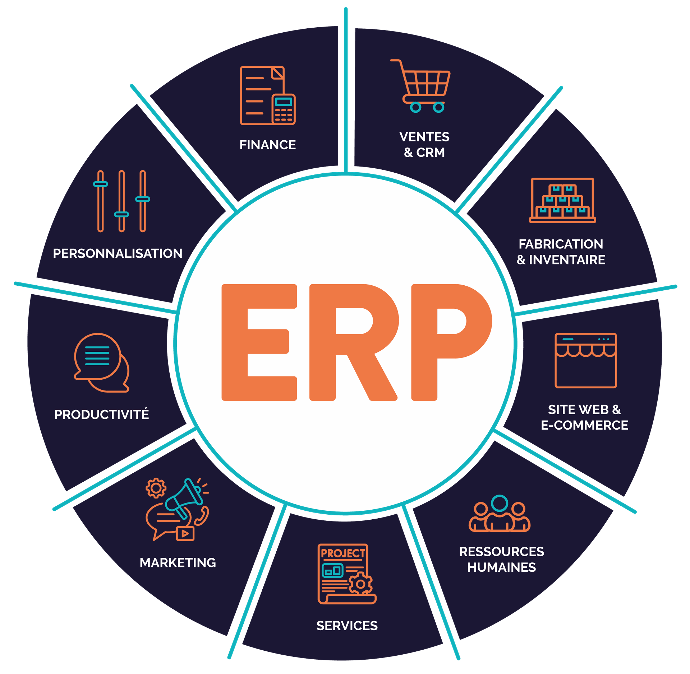
Theintegration of a CRM system for customer relationship management and ERP for enterprise resource planning can be vitally important in streamlining business operations and optimising performance and productivity.
Why integrate CRM and ERP?
Integrating a CRM and ERP system into your business offers a host of advantages, the main ones being as follows.
"Integrating a CRM and an ERP system means you can centralise all the data you and your teams need in a single system." Thanks to real-time synchronisation and updating, you give your staff access to the most up-to-date information.
In addition, using a CRM and an ERP helps to make the same data available to teams in different departments. This helps to break down data silos and improve understanding of performance.
By combining CRM with ERP, you will be able to identify the impact of different factors on your sales and business performance. For example, you can easily track your marketing operations and understand their impact on sales and the various operations of your business.
Centralising data offers an advantage when you want to generate reports and analyses of company activities. Because information is stored in a single database, you benefit from a consolidation of data to better guide your decision-making.
"Integrating a CRM and an ERP system means you can centralise all the data you and your teams need in a single system." Thanks to real-time synchronisation and updating, you give your staff access to the most up-to-date information.
In addition, using a CRM and an ERP helps to make the same data available to teams in different departments. This helps to break down data silos and improve understanding of performance.
By combining CRM with ERP, you will be able to identify the impact of different factors on your sales and business performance. For example, you can easily track your marketing operations and understand their impact on sales and the various operations of your business.
Centralising data offers an advantage when you want to generate reports and analyses of company activities. Because information is stored in a single database, you benefit from a consolidation of data to better guide your decision-making.
Improving operational efficiency
CRM and ERP are designed to automate certain tasks, centralise data and make it easier to access. These management software packages can be used to manage customer relations and optimise the company's internal management.
Combining the functionalities of CRM and ERP creates an extremely powerful tool that significantly optimises business productivity. This translates into :
- Save time by centralising data and making it accessible with just a few clicks. Your staff can communicate more effectively, and you can significantly reduce the risk of errors linked to out-of-date information;
- automate certain tasks to reduce your employees' workload;
- limiting manual data entry saves time and reduces the risk of errors.
CRM and ERP are designed to automate certain tasks, centralise data and make it easier to access. These management software packages can be used to manage customer relations and optimise the company's internal management.
Combining the functionalities of CRM and ERP creates an extremely powerful tool that significantly optimises business productivity. This translates into :
- Save time by centralising data and making it accessible with just a few clicks. Your staff can communicate more effectively, and you can significantly reduce the risk of errors linked to out-of-date information;
- automate certain tasks to reduce your employees' workload;
- limiting manual data entry saves time and reduces the risk of errors.
Optimising the customer experience
Implementing a CRM and ERP system for your business gives you a detailed view of each customer's habits. By collecting, aggregating andanalysing data, you can identify customers' preferences, purchase histories and profiles, so you can better target their needs. You can then offer them products or services that really suit them and that they are more likely to buy.
By using CRM and ERP functionalities, you can coordinate and facilitate customer service tasks. You'll be able to put in place better organisation and optimise communication between the teams involved to respond effectively to customer requests and guarantee their satisfaction.
Implementing a CRM and ERP system for your business gives you a detailed view of each customer's habits. By collecting, aggregating andanalysing data, you can identify customers' preferences, purchase histories and profiles, so you can better target their needs. You can then offer them products or services that really suit them and that they are more likely to buy.
By using CRM and ERP functionalities, you can coordinate and facilitate customer service tasks. You'll be able to put in place better organisation and optimise communication between the teams involved to respond effectively to customer requests and guarantee their satisfaction.
Adaptability to changes in your business
ERP and CRM systems can evolve to adapt to the growth of your business. What's more, they regularly incorporate new functionalities to respond to market demands and fluctuations.
The flexibility offered by these systems guarantees efficiency and relevance in all circumstances.
Installing a CRM and ERP system is an excellent investment for your company. These tools optimise both internal management and customer relations by centralising and providing access to crucial information. If you want to maximise your chances of growing and sustaining your business, it would be wise to integrate these solutions into your company's strategy.
ERP and CRM systems can evolve to adapt to the growth of your business. What's more, they regularly incorporate new functionalities to respond to market demands and fluctuations.
The flexibility offered by these systems guarantees efficiency and relevance in all circumstances.
Installing a CRM and ERP system is an excellent investment for your company. These tools optimise both internal management and customer relations by centralising and providing access to crucial information. If you want to maximise your chances of growing and sustaining your business, it would be wise to integrate these solutions into your company's strategy.
In all this strategy, coupling with your accounting is also a major advantage. Everything is centralised, with perfect integration to ensure fluidity and seamless management.