
Optimising your website's SEO for better visibility
Gain a better understanding of the issues involved and the actions to be taken to implement a sound SEO strategy.
Have you ever heard of natural or paid search engine optimisation? SEO or SEA? Are you looking for advice or a digital marketing agency to boost your website's ranking so that it is visible on Google? In this article, you'll find the answers to your questions and some advice.
to improve your company's
your business on the internet. Don't hesitate to contact us directly if you need advice or are looking for a partner to set up your website or SEO strategy.

SEO or SEA
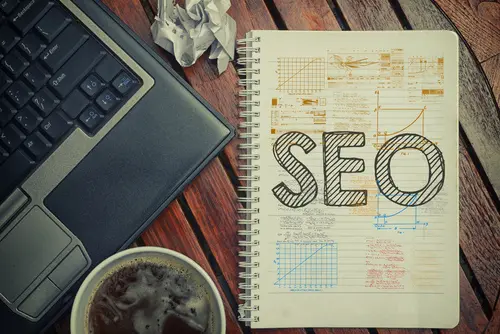
SEO: Search Engine Optimization
SEO, also known as natural search engine optimisation, is an optimisation process and a strategy for improving your website's position in search engines on defined keywords. SEO involves working on the structure, code and content of your website as well as outside it, taking into account its reputation, popularity and the way it is linked to other sites via backlinks.
SEA: Search Engine Advertising
SEA, also known as paid search, involves setting up one or more paid campaigns to generate traffic or conversions on your website. Google's Adwords campaigns are the most widely used and enable you to implement advanced strategies to target your prospects effectively.
What elements of your site have an impact on SEO?
Generally speaking, all the content on your site will have an impact on SEO, but Google is more sensitive to certain elements.The structure of your site
It is important that each page has a good structure and contains only one H1 tag for a title. This will enable Google to know what the page is about and to suggest it after a query in the same domain. Unlike your sub-headings, where you have the right to use several H2 or H3 tags. It is important to place keywords in these titles, and the sooner the better.
Title and meta-description tags
Google and search engines in general use the tags on your website to retrieve information. Your site's title and meta-description tags will ensure that the correct information is displayed in the search results and that your pages are optimised.

The names, alt and descriptions of your images
Another factor that Google looks at when indexing your site is the use of images with textual content behind them, known as alternative text or "Alt" tags. This is text that describes what the image is supposed to represent and that will be displayed when the image is not displayed correctly to inform users who are unable to see the illustration what the content is and thus avoid frustration.
It is also preferable to use images whose filenames are keywords without capitals and to replace spaces with "-" rather than "_". You should also pay attention to the size of your images (ideally around 100 Kb but no more than 1Mb). If your images are too heavy, this will have an impact on the loading time for displaying them to web users, who may leave the page after waiting too long.
Beware of over-optimisation
It is important not to abuse certain practices, such as using long URLs filled with keywords or quoting them one after the other. This kind of behaviour will lead to penalties on your SEO score awarded by Google.

Internal links
It is also important to create hyperlinks on your site. These are clickable highlighted words that will take the user to another of your pages dealing with the highlighted word. The more links a page has pointing to it, the more importance Google will give it.
The XML sitemap
Another important point that can help search engines is the integration of an XML sitemap within the code of your site. Its purpose is to "create" a map of your site in the form of one or more files. It can reference up to 50,000 pages, often in the case of large e-commerce sites or blogs with a lot of content. It is possible to have several sitemaps for large websites.
Duplicate content
Google does not like duplicate content. There are three forms of duplicate content:
- Two identical pages
- Two similar pages, but with different <Title> and <Description> tags
- Two different pages, but with the same <Title> and <Description> tags
In all cases, it is essential to ensure that your site contains unique and original content.
Long-term recognition of your site
Once the content of your pages and the structure of your site have been optimised, it's important to remember that SEO needs to be worked on regularly and over the long term. Implementing a backlinks strategy will enable you to increase the popularity of your website and improve your positions on the keywords you have chosen.
You should also bear in mind that Google's algorithms and those of other search engines are constantly evolving. This is one of the reasons why many marketing agencies offer subscriptions to optimise your website's SEO on a monthly or weekly basis.
Looking for a partner to improve your SEO?

