

Do you have an online shop on Shopify and use Odoo for your back office? Are you looking for an efficient solution to link these two applications ? This is undoubtedly the right time to think about a genuine connection between your ERP and your e-commerce site. What if 2025 were the year of a successful integration, without hassle or wasted time?
Odoo and Shopify : A connection that redefines e-commerce
On a daily basis, managing an online shop involves dozens of tasks: order processing, stock updates, customer tracking, product management, sales analysis... The truth is that using multiple tools that do not communicate with each other complicates everything. And it often costs a great deal in time and errors.
The good news? A well-executed connection between Odoo and Shopify makes it possible to centralise all your data. You move from a silo-based operation to a fluent system, where each application has its place. Your ERP becomes the heart of your commerce, and your site a channel that integrates perfectly into the chain.

What the integration truly enables
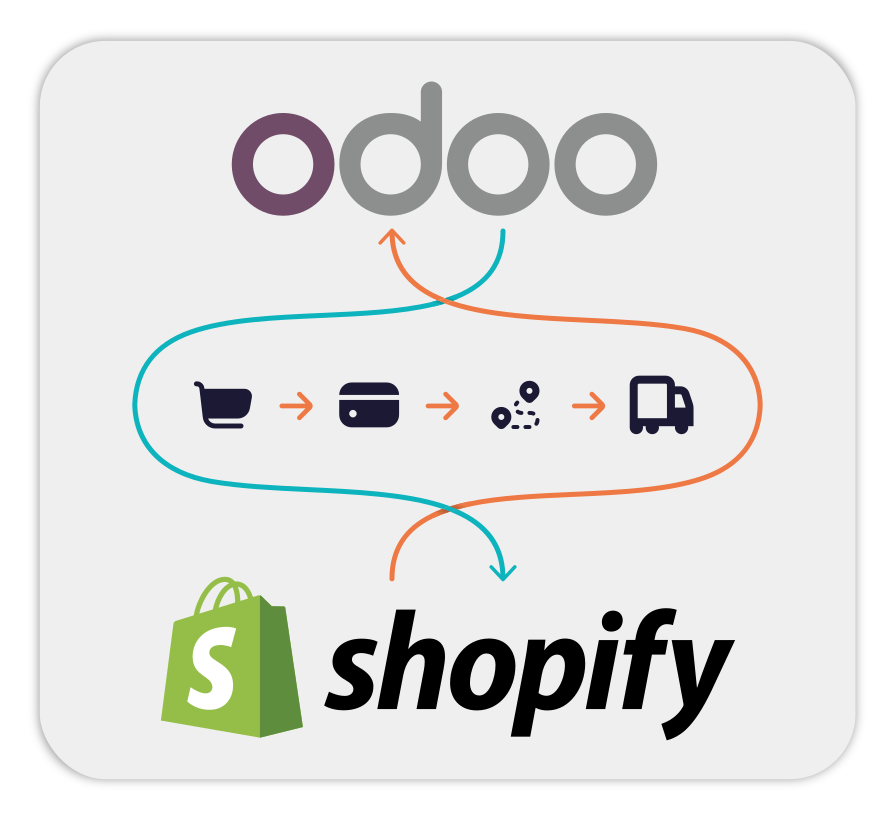
Every action on your Shopify site can be automatically relayed to Odoo: a validated order, a new customer, a change in price or stock.
In just a few clicks, you get real-time synchronisation of products, catalogues, and available quantities. You avoid double entry, oversights, and delays in updating. And above all, you improve your responsiveness. Because a customer who gets a quick response is a satisfied customer.
By linking the two platforms, you create a harmonious working environment, where data flows without a hitch. You reduce internal friction and gain in agility.

Configuration and connector : the keys to an effective link
Obviously, everything rests on the configuration. A good integration does not happen in 3 magic clicks. You need to take the time to choose a suitable connector, capable of making Shopify and Odoo communicate without conflict or data loss. We are talking about flows, formats, permissions. In short, well-thought-out technique.
The ideal approach is to start with a quick audit of your needs. Which features are indispensable to you? Which modules do you need? Who will use what? By answering these questions, you avoid unpleasant surprises and gain clarity.

Smoother management, a more serene daily routine
The greatest advantage? It is simplicity regained. You can manage your sales, stock, orders, and returns without leaving Odoo. Every operation is automatically linked to your site, your customers, your statistics. And all of this, without having to multiply the interfaces.
No more need to rush between tools to find out where a product or shipment stands. Everything is there, in your ERP, ready to be analysed, managed, optimised. You save a tremendous amount of time, reduce errors, and finally focus on what creates value.

Support: an aspect too often overlooked
A good system is fine. Good support is better. Choosing a connector that offers responsive assistance is a real plus. Because a bug can happen. A data conflict too. And in those cases, having someone who responds quickly and understands your context makes all the difference.
Make sure that the chosen solution includes genuine technical support. It is not just a FAQ or an automatic chatbot. You want a human, or at least a real contact who will be able to guide you when things get stuck.
And for your business, what does it change?
This integration can transform your daily life. You make your business more efficient, your organisation smoother, your teams more autonomous. By linking Shopify to Odoo, you give your company the means to be more agile, more precise, more competitive.
You have a clear vision of your activities. You anticipate better. You respond more quickly. And above all, you make room for strategy, innovation, and customer relations. In short, for the human element.

